
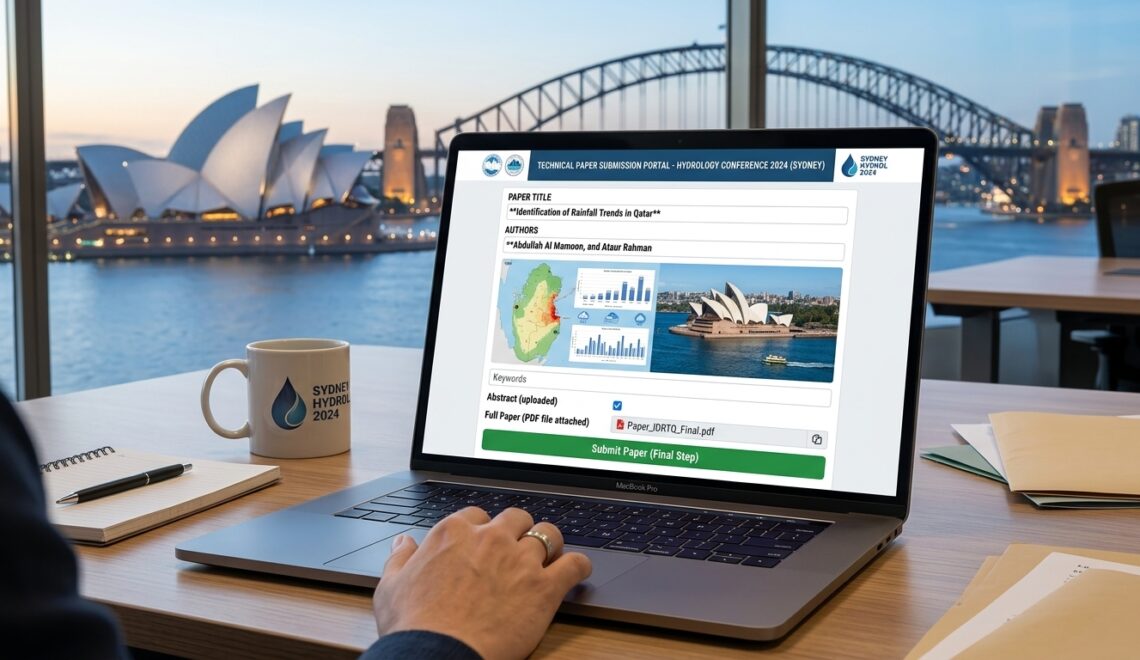
Abstract: Due to climate change, future rainfall will change at many locations on Earth; however, the spatial and temporal patterns of this change are not easy to predict. One approach of predicting such future changes is to examine the trends in the historical rainfall data at a given region and use the identified trends to make future predictions. For this, a statistical trend test is commonly applied to the historical data. This paper examines the trends of daily extreme rainfall events from 30 rain gauges located in the State of Qatar. Rainfall data covering the period from 1962 to 2011 were used in the analysis. A combination of four non-parametric and parametric tests was applied to identify trends at 10%, 5% and 1% significance levels. These tests are Mann-Kendall (MK), Regression (LR) and CUSUM tests. These tests showed both positive and negative trends throughout the country. Only eight stations showed positive (upward) trends, which were, however, not statistically significant. In contrast, significant negative (downward) trends were found at the 5% and 10% levels of significance in six stations. The MK, SR and LR tests exhibited very similar results. This finding has important implications in the derivation/upgrade of design rainfall for Qatar, which will affect the design and operation of future urban drainage infrastructure in Qatar.
Keywords: Trends, extreme rainfall, daily rainfall, Mann-Kendall test, climate change, Qatar.
International Conference on Environmental Systems Science and Engineering, 15 -16 Dec 2014, Sydney, Australia, 8, 12, Part VI, 735-739.